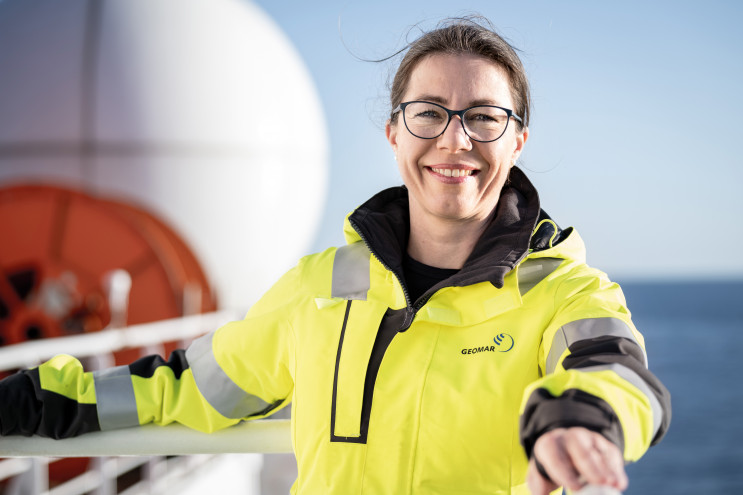
A leading ocean scientist sees opportunities to expand cooperation amid efforts to hinder research
Some policymakers continue to question the science of climate change, despite the growing evidence of significant damage to life on land and in the ocean.
Katja Matthes, director of the GEOMAR Helmholtz Centre for Ocean Research Kiel in Germany, believes the ongoing attempts to politicise climate science and discredit researchers are hindering international cooperation and public understanding. The ocean provides clear evidence of the extent to which changes are occurring, she says.
“We are seeing severe, unprecedented and accelerating changes in the ocean — warming ocean temperatures, acidification and oxygen depletion — that are destabilising the most important system that makes life on this planet possible,” Matthes explains. Visible signs of these changes include the melting of ice sheets in the Arctic and Greenland. Deeper down, the growing frequency of hypoxia — or oxygen-deprived “dead zones”, where marine life can no longer survive — in the Baltic and record-high Mediterranean surface temperatures are indicators of the “dramatic warming” of the ocean, she adds.
The ocean, which covers around 70% of the Earth’s surface, acts as a vital carbon sink, absorbing around 30% of the planet’s carbon dioxide (CO2) and 90% of the excess heat. However, the global ocean surface temperature has risen by an average of half a degree Celsius since 1982, according to the EU Copernicus observatory. More significant rises have been recorded in the Mediterranean, Black, Baltic and other shallower seas.
Some ocean temperature increases do occur naturally, such as during El Niño events. But sustained rises can trigger extreme weather on land — including droughts, floods and catastrophic storms — while also harming marine ecosystems. Only 10% of marine species have been studied, Matthes notes, “so the consequences might be even more severe than we know.”
Fostering European cooperation amid uncertainty
Matthes, who holds a doctorate in meteorology, is a professor of atmospheric physics as well as director of GEOMAR. She serves as one of Kiel’s ambassadors to Science Comes to Town (SCTT), an EU-funded programme that aims to promote science’s role in society and strengthen cross-border collaboration in research, innovation and sustainability. SCTT is hosted by the coastal cities of Kiel, Brest (in France) and Split (in Croatia).
The SCTT project also provides a platform for raising awareness and understanding between scientists and the public about major issues, such as climate change. Having worked on both sides of the Atlantic, Matthes is frustrated by recent attempts to erode decades of international climate collaboration and question the credibility of research.
Earlier this year, the US administration delivered a major blow to global cooperation by withdrawing from the Intergovernmental Panel on Climate Change (IPCC), the UN Framework Convention on Climate Change and other global climate organisations, claiming they were “contrary to the interests of the United States.”
In addition, a US Department of Energy (DOE) report cast doubt on the latest IPCC climate assessment, which was published in 2024. As a contributing author to the IPCC study, Matthes says the DOE sought to discredit scientists like herself. “Climate change is not a matter of opinion, it really exists and we are witnessing dramatic changes,” she notes. “It’s not climate change as a whole that is being targeted, but scientists and their research.”
Other US actions have also hit home for Matthes, who spent three years at the US National Center for Atmospheric Research (NCAR) in Boulder, Colorado. The White House has announced plans to close the facility, a move that was “pretty tough” due to the German scientist’s personal connections with the staff and their reputation for excellence.
Changing the narrative on climate change
Europe’s scientific community remains a driving force on climate research and collaboration. As one of the world’s leading marine research institutions, GEOMAR attracts students from more than 50 countries and plays an important role in global observation initiatives that contribute to understanding and protecting the ocean basins.
At a European level, GEOMAR works closely with other top marine research facilities, including France’s Ifremer, an SCTT partner in Brest. GEOMAR has also developed innovative and safe strategies for removing unexploded wartime munitions from the seabed, which release toxic substances that pose a danger to humans and the marine environment. Through the Horizon Europe MMinE-SwEEPER project, this knowledge has been transferred to the European level.
These initiatives are examples of how local action can have a global impact, Matthes says, and how Europe can strengthen climate research and partnerships. “This is a chance for Europe to step up and work on climate cooperation and agreements,” she notes. “Climate change is an international problem and a real threat, and we need more speed on climate action than we have now.”
Matthes believes her fellow scientists need to communicate that climate change is not only a threat, but an opportunity to find solutions. “We need to change our narrative and expand our strategic alliances with those who are willing,” she says, “and luckily there are a lot of willing people and countries.”
Science|Business, which connects policymakers, academics and industry through its news reporting, analysis and events, is an SCTT partner. Find the original article here: A deep dive into climate change | Science|Business